Documentation Home Page ◇ Hardware Home Page
Pour la documentation en FRANÇAIS, utilisez l'outil de traduction de votre navigateur Chrome, Edge ou Safari. Voir un exemple.
OP5707-IO Front Interface
- Sylvain Ménard
In the front of the unit, the OP5707-IO 2nd Edition has one round button with an integrated LED indicator (B), while the 1st Edition has a toggle switch with LED indicator (B) above.

OP5705-IO 2nd Edition with one round button and an integrated DEL indicator (B)

OP5707-IO 1st Edition with a toggle switch and a LED indicator (B)
A. RJ45 connector panels provide connections to monitor signals from I/O modules.
- Each connector is linked to one I/O module on the carrier board.
- Analog I/O modules (channels 0-15) will use only the first column of connectors.
- Digital I/O modules will use both columns:
- Channels 0-15 in the first column
- Channels 16-31 on the second column
- See the RJ45 Connectors section in the IO Connectors page for detailed information.
B. Power switch/button with LED indicator
C. SFP (Small Form-factor Pluggable) ports controlled from the FPGA, for MUlti-System Expansion (MuSE) communication with other FPGA simulators or with third-party devices.
- Each socket controls one communication link.
- SFP transceivers and fiber optic cables must be selected according to the type and speed of the communication protocol implemented in the FPGA (OPAL-RT MuSE link or third-party device connection).
- MuSE link requires specific SFP and cable:
- SFP: Avago AFBR-57R5APZ
- Cable: LC-LC multimode 850 nm optical fiber
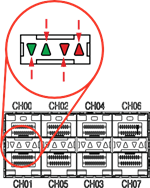
- The LEDs (light pipes) associated with the selected channel will light to indicate the channel is selected.
- LEDs are arrow-shaped to indicate the channels to which they are associated.
- The LED upward arrow points to the top channel
- The LED downward arrow points to the bottom channel (see below)
LED | Color | State Description |
|
| Green Red | ON: SFP is inserted | OFF: No SFP is present | BLINK: Channel active OFF: Connection OK | ON: transmission fault | BLINK: Reception loss |


D. Synchronization connectors (fiber optic and audio) and a series of four LEDs on the front panel display the device status.
LED | Power On | After Load & During Execution | After Reset |
|---|---|---|---|
Tx | Off | Green** | Off |
Rx | Off | Green** | Off |
M/S | Default* | Orange = Slave | Green |
PWR | Green | Green | Green |
*The color of the LED on power-on depends on the default FPGA configuration:
- When the FPGA board is programmed in Slave synchronization mode, the LED will be orange.
- When it is programmed in Master mode, the LED will be green.
**Tx and Rx provide synchronization information.
- When transmitting the synchronization signal, the Tx LED will be green.
- When receiving the synchronization signal, the Rx LED will be green.
E. RJ45 connectors with mini-BNC terminals for monitoring.
- Mini-BNC connectors allow for quick cable connections to monitoring devices (such as an oscilloscope).
F. USB JTAG for VC707 FPGA (for OPAL-RT technicians’ use only).
OPAL-RT TECHNOLOGIES, Inc. | 1751, rue Richardson, bureau 1060 | Montréal, Québec Canada H3K 1G6 | opal-rt.com | +1 514-935-2323
Follow OPAL-RT: LinkedIn | Facebook | YouTube | X/Twitter